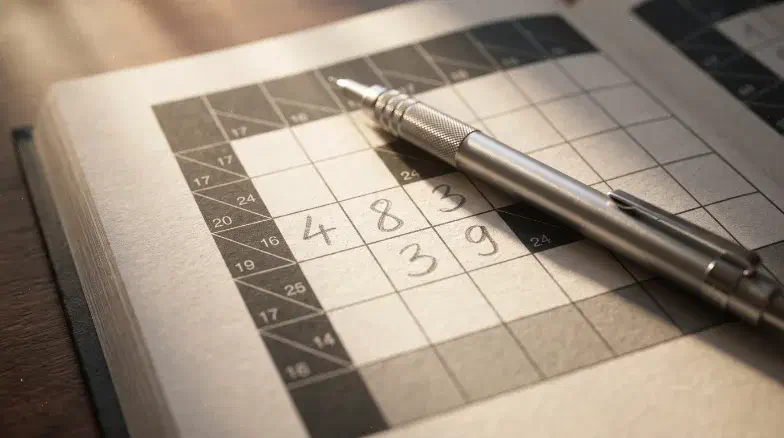
Your first Kakuro grid looks like a crossword someone forgot to finish. Black squares are slashed with diagonal lines, small numbers sit in their corners, and rows of empty white boxes wait for you. You pick the first clue you see, a 15 across three cells, and start trying combinations. 9, 5, 1? 8, 4, 3? 7, 6, 2? Ten minutes later your eraser has worn a shiny patch into the paper and you haven’t committed a single digit.
You haven’t done anything wrong. You’ve just started in the wrong place. That 15 has eight different valid combinations, and nothing on the board tells you which one is right yet. Somewhere else on that same grid sits a clue with exactly one possible answer, and that’s where every solve should begin.
Kakuro rewards a specific order of operations: read the grid correctly, find the clues that can only be solved one way, then use the places where clues cross to pin down exact digits. None of it requires guessing. All of it requires knowing where to look first.
The Anatomy of a Kakuro Grid
Kakuro has been around longer than most people expect. Dell published it as Cross Sums in 1950, and Nikoli brought it to Japan in 1980 under the name Kasan Kurosu, which roughly means “addition cross.” Nikoli shortened that to Kakuro in 1986, and the name stuck. The rules have barely changed since.
Reading the Clues
Nikoli’s official rules boil down to three lines:
- Put a digit from 1 to 9 in every white cell. No zeros, no two-digit numbers.
- A number in a cell split by a diagonal line gives the sum of the consecutive white cells to its right or below it.
- No digit may appear more than once in the same run of consecutive cells.
The black cells hold the clues. When a black cell is split diagonally, the number in the top-right triangle belongs to the white cells running to the right. The number in the bottom-left triangle belongs to the white cells running down. A black cell can carry one clue, both, or none.
Each unbroken run of white cells is called an entry. An entry starts right after its clue cell and stops at the next black cell or the edge of the grid. Entries are always at least two cells long and never more than nine. A nine-cell entry has to use every digit from 1 to 9 once, so its clue is always 45.
In the diagrams throughout this series, a clue cell is written as down\across. So 3\ is a down clue of 3, \4 is an across clue of 4, and 24\16 carries both: 24 for the entry below it, 16 for the entry to its right.
+-------+-------+-------+
|#######|  3\   |  9\   |
+-------+-------+-------+
|   \4  |       |       |
+-------+-------+-------+
|   \8  |       |       |
+-------+-------+-------+
This small corner has four entries. The \4 cell says the two white cells to its right add up to 4. The 3\ cell says the two white cells below it add up to 3. The top-left white cell belongs to both of those entries at once, and that overlap is where the solving happens.
The no-repeat rule applies only within an entry. A clue of 4 across two cells can’t be 2 + 2. But the same row can hold two 4s if a black cell splits them into separate entries. The rule doesn’t care about rows or columns the way Sudoku does. It cares only about the entry.
The “No Trial and Error” Rule
Every published Kakuro has exactly one solution, and you can reach it by deduction alone. Guessing feels faster, but it isn’t.
Take the corner above. The top-left white cell sits in the across 4, which has to be 1 + 3. Suppose you guess it’s the 3. The across entry looks fine: 3 + 1 = 4. Now check the down entry. The down 3 needs two cells that add to 3, and you’ve already spent 3 on the first one. The second cell would have to be 0, which doesn’t exist.
In a 2x2 corner, the contradiction shows up in one move. On a 10x10 grid, a bad guess can survive for twenty moves before something finally fails to add up, and by then you can’t tell which digit started it.
Instead of committing, write pencil marks: small candidate digits in the corner of a cell. They cost nothing to erase and they keep every option visible until the logic narrows it to one.
The Magic of Unique Sums
Some clues can only be made one way. These unique sums are the foothold on any grid, and you should find all of them before you write a single final digit.
The Extremes: Highs and Lows
The smallest two-cell sum is 3, and the largest is 17. At both ends, the options run out fast.
- 3 in two cells: 1 + 2. Nothing else works.
- 4 in two cells: 1 + 3. The only other option, 2 + 2, repeats a digit.
- 16 in two cells: 7 + 9. The only other option, 8 + 8, repeats a digit.
- 17 in two cells: 8 + 9. Nothing else works.
Compare that to a 5 in two cells, which could be 1 + 4 or 2 + 3. One extra point of sum doubles your options. A 10 in two cells has four options (1+9, 2+8, 3+7, 4+6), so it tells you almost nothing on its own.
When you spot a 3, 4, 16, or 17 over a two-cell entry, you know both digits immediately. You don’t know their order yet, but you know the set, and that’s enough to pencil them in.
Extended Unique Sums
The same squeeze happens on longer entries. Every entry length from two to seven cells has exactly four unique sums, two at the low end and two at the high end. Conceptis Puzzles calls these “magic blocks.”
| Entry length | Unique low sums | Unique high sums |
|---|---|---|
| 2 cells | 3 = {1,2} · 4 = {1,3} | 16 = {7,9} · 17 = {8,9} |
| 3 cells | 6 = {1,2,3} · 7 = {1,2,4} | 23 = {6,8,9} · 24 = {7,8,9} |
| 4 cells | 10 = {1,2,3,4} · 11 = {1,2,3,5} | 29 = {5,7,8,9} · 30 = {6,7,8,9} |
| 5 cells | 15 = {1,2,3,4,5} · 16 = {1,2,3,4,6} | 34 = {4,6,7,8,9} · 35 = {5,6,7,8,9} |
There’s a shortcut for remembering the high side. Swap each digit in a low set for 10 minus that digit, and you get its high twin. {1,2} becomes {9,8}, so 3 pairs with 17. {1,2,4} becomes {9,8,6}, so 7 pairs with 23.
To scan a new grid, ignore everything in the middle range on your first pass. Look for small numbers over short entries and big numbers over short entries. Pencil in the digit sets as you find them. Small beginner grids are packed with these. The 6x6 practice grid in Kakuro Unique Sums has nine of them, and you can find every one before you’ve done any real thinking.
Cross-Referencing: Your Most Powerful Tool
Unique sums tell you which digits. Cross-referencing tells you where.
Finding the Intersection
Every white cell belongs to exactly two entries: one across and one down. Whatever digit goes in that cell has to work for both clues. If the across entry allows {1,3} and the down entry allows {1,2}, the shared cell can only hold a digit that appears in both sets. That’s 1.
This is the whole engine of Kakuro. Each clue on its own is a small arithmetic problem with several answers. Two clues crossing at one cell shrink each other’s options, often down to a single digit.
The “Forced Digit” Deduction
Once you place a digit, every entry it touches gets smaller. Say a 10 runs across three cells and you’ve just placed a 1 in one of them. The remaining two cells now need to sum to 9, and they can’t use 1. That leaves {2,7}, {3,6}, or {4,5}. You’ve turned a three-cell problem into a two-cell problem.
Sometimes that shrinking leaves exactly one option. When an entry has one empty cell left, its value is simply the clue minus everything already placed. That’s a forced digit: no choice involved, just subtraction. Placing it then shrinks the other entry that cell belongs to, and the chain continues.
Practical Example: Solving a Corner
Back to the corner from earlier. This time, solve it.
+-------+-------+-------+
|#######|  3\   |  9\   |
+-------+-------+-------+
|   \4  |       |       |
+-------+-------+-------+
|   \8  |       |       |
+-------+-------+-------+
Step 1: Find the unique sums. The across 4 over two cells must be {1,3}. The down 3 over two cells must be {1,2}. Pencil them in.
+-------+-------+-------+
|#######|  3\   |  9\   |
+-------+-------+-------+
|   \4  |  1 3  |  1 3  |
+-------+-------+-------+
|   \8  |  1 2  |       |
+-------+-------+-------+
Step 2: Look at the intersection. The top-left white cell carries {1,3} from the across clue and {1,2} from the down clue. The only digit in both sets is 1.
Step 3: Write the digit. The top-left cell is 1.
Step 4: Finish both entries. The across 4 needs 4 − 1 = 3 in the next cell. The down 3 needs 3 − 1 = 2 in the cell below.
+-------+-------+-------+
|#######|  3\   |  9\   |
+-------+-------+-------+
|   \4  |   1   |   3   |
+-------+-------+-------+
|   \8  |   2   |       |
+-------+-------+-------+
Step 5: Take the forced digit. The bottom-right cell is the last empty cell in two entries. The across 8 needs 8 − 2 = 6. The down 9 needs 9 − 3 = 6. Both clues agree, which is your confirmation.
+-------+-------+-------+
|#######|  3\   |  9\   |
+-------+-------+-------+
|   \4  |   1   |   3   |
+-------+-------+-------+
|   \8  |   2   |   6   |
+-------+-------+-------+
Four cells, zero guesses. Every digit came from either a unique sum, an intersection, or subtraction. That same loop solves full grids:
The Kakuro Solving Loop
Visualizing the core deduction cycle:
graph TD
    A[1. Scan for Unique Sums] --> B[Pencil in Digit Sets]
    B --> C{2. Intersect Entries}
    C -->|Single Shared Candidate| D[3. Place Digit]
    C -->|Multiple Candidates| C
    D --> E[Subtract Digit from Both Clues]
    E --> F[4. Update Pencil Marks]
    F --> G{Are Clues Fulfilled?}
    G -->|No| C
    G -->|Yes| H[Check Addition]
    H --> C
- Scan for unique sums and pencil in their digit sets.
- Intersect crossing entries to find cells with a single shared candidate.
- Place the digit and subtract it from both entries it belongs to.
- Update pencil marks in both entries, then look for the next forced digit.
Do’s and Don’ts
Do:
- ✓ Scan the entire grid for unique sums before writing anything in pen.
- ✓ Use small pencil marks for candidates and erase them as soon as they’re ruled out.
- ✓ Check the addition in both directions every time you complete an entry.
Don’t:
- ✗ Place a digit because it fits one clue. It has to fit both.
- ✗ Repeat a digit inside an entry, even in a long one where the first cell is far away.
- ✗ Ignore the crossing point of two long entries. Late in a solve, those often hold the forced digit you need.
Troubleshooting Common Issues
“I’m stuck and can’t find the next move.” Usually you’ve missed an intersection, or you placed a digit and didn’t update the pencil marks around it. Re-scan the grid for entries that now have fewer empty cells. A five-cell 25 with three digits placed is now a two-cell problem, and it might be a unique sum. To prevent this, trace both the across and down entries every time you write a permanent digit.
“My last cell doesn’t add up.” Somewhere upstream there’s an arithmetic slip or a repeated digit. Work backward through the entry that failed, then through each crossing entry, checking sums and duplicates as you go. Most broken grids trace back to a single wrong digit. To prevent this, re-add every entry in both directions as you finish it, not at the end.
Conclusion
Kakuro looks like a math test, but the arithmetic is the easy part. The skill is knowing where to start and refusing to guess.
Key takeaways:
- Kakuro rewards logic, not trial and error. Every digit can be proven.
- Unique sums such as 3, 4, 16, and 17 in two cells are your starting anchors.
- Every white cell has to satisfy both its across clue and its down clue.
- Cross-referencing two crossing entries reveals forced digits, and each placed digit shrinks the problem further.
Next steps: Print a beginner grid, run a unique-sum scan before you write anything in pen, and work outward from the corners. When the 2-cell sums feel automatic, start memorizing the 3-cell and 4-cell sets from the table above.
Keep reading in this series:
- Understanding Kakuro Rules and Grid Mechanics: the rules in depth, including the edge cases that trip up new solvers.
- Kakuro Unique Sums: The Magic of 3, 4, 16, and 17: a full anchor scan on a real grid.
- How to Cross-Reference Intersecting Kakuro Clues: what to do when the intersection isn’t obvious.
- Common Kakuro Mistakes Beginners Make and How to Avoid Them
- Transitioning from Sudoku to Kakuro: What Changes?