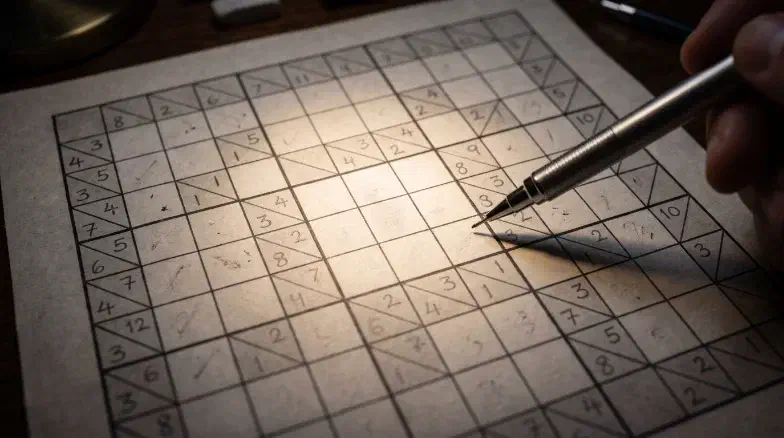
You’ve hit a wall in an expert Kakuro. Every magic block on the page is filled in, every easy crossing is done, and a fat block of empty cells is sitting in the middle of the grid. Each clue around it has five or six workable combinations. You pencil a few, erase them, and pencil them again.
If you’ve played Killer Sudoku, your hand goes to the 45 rule. Every 3×3 box holds 1 through 9, so add up the cages, subtract from 45, and the missing cell falls out. You try it here, and you get 13 for a single cell.
Nothing is wrong with your arithmetic. You’ve hit the one place where the Sudoku version of the rule doesn’t carry over. A Kakuro block has no duty to hold 1 through 9. The idea underneath the 45 rule does carry over, though, and in Kakuro it’s even simpler.
The Foundation of the 45 Rule
The Math Explained
1 + 2 + 3 + 4 + 5 + 6 + 7 + 8 + 9 = 45. Any region that has to contain each digit exactly once must sum to 45, which is why the rule works in Killer Sudoku, where every row, column, and box is such a region.
Kakuro only promises no repeats within a single entry, the run of white cells under one clue. Two different entries can reuse the same digits as often as they like. Fill an open 3×3 block like this and every row and column is legal:
1 2 3
2 3 1
3 1 2
That block sums to 18, not 45. So in Kakuro, 45 is guaranteed in exactly one place: an entry nine cells long. That clue is always 45 (Wikipedia notes the clue is simply written “45”, because the nine cells are implied), and it tells you nothing about order.
Finding the Remainder
The literal 45 becomes useful one step down. An eight-cell entry uses eight of the nine digits, so the one it skips is 45 minus the clue. A 38 in eight cells is missing 7. A 44 is missing 1. Every eight-cell clue from 36 to 44 is a magic block. You just read it through a subtraction instead of a table.
The same trick works for shorter long entries:
| Entry | Clue | 45 − clue | Missing digits | Digits used |
|---|---|---|---|---|
| 8 cells | 38 | 7 | {7} | {1,2,3,4,5,6,8,9} |
| 7 cells | 41 | 4 | {1,3} | {2,4,5,6,7,8,9} |
| 7 cells | 30 | 15 | {6,9} or {7,8} | two options |
| 6 cells | 39 | 6 | {1,2,3} | {4,5,6,7,8,9} |
Read the table sideways and you’ll see that a long entry is a short entry in disguise. A 41 in seven cells is just “4 in two cells”, turned inside out, and you already know that’s {1, 3}. The 30-in-seven row matches the example Wikipedia uses to show that 30 in seven cells has exactly two possible sets.
Innies and Outies
The bigger idea behind the 45 rule isn’t 45. It’s counting the same cells twice.
Pick a region of the grid. Add every across clue whose entry sits completely inside it, and you get the total of the cells those entries cover. Do the same with the down clues. If the across entries and down entries cover exactly the same cells, the two totals match and you’ve learned nothing. If one side covers one extra cell, the difference between the totals is that cell.
Killer Sudoku players call the extra cell an innie or an outie, and Wikipedia’s Killer Sudoku article gives the 45-based formulas. In Kakuro you don’t need 45 at all. You compare across against down.
Calculating an “Outie”
An outie is a cell outside your region that gets dragged into the count because one of your entries runs past the edge. Here’s the grid this article will solve. Clue cells read down\across: 8\ is a down clue of 8, and \19 is an across clue of 19.
+-------+-------+-------+-------+-------+-------+
|#######| 11\   | 12\   |  8\   |#######|#######|
+-------+-------+-------+-------+-------+-------+
|   \10 |   ·   |   ·   |   ·   |#######|#######|
+-------+-------+-------+-------+-------+-------+
|   \19 |   ·   |   ·   |   ·   | 10\   | 17\   |
+-------+-------+-------+-------+-------+-------+
|#######|#######|   \18 | OUTIE |       |       |
+-------+-------+-------+-------+-------+-------+
|#######|#######|#######|   \11 |       |       |
+-------+-------+-------+-------+-------+-------+
The dotted cells form a 2×3 block. The across clues 10 and 19 cover it exactly: 10 + 19 = 29. The down clues 11, 12, and 8 also cover it, but the 8 runs one cell further down. So 11 + 12 + 8 = 31 counts the block plus that cell.
Outie = (clues that run outside) − (clues that fit inside) = 31 − 29 = 2.
Calculating an “Innie”
An innie is the reverse: a cell inside your region that one direction counts and the other doesn’t, because its entry in that direction leaves the region.
+-------+-------+-------+-------+-------+-------+
|#######| 11\   | 12\   |  8\   |#######|#######|
+-------+-------+-------+-------+-------+-------+
|   \10 |       |       |       |#######|#######|
+-------+-------+-------+-------+-------+-------+
|   \19 |       |       |       | 10\   | 17\   |
+-------+-------+-------+-------+-------+-------+
|#######|#######|   \18 | INNIE |   ·   |   ·   |
+-------+-------+-------+-------+-------+-------+
|#######|#######|#######|   \11 |   ·   |   ·   |
+-------+-------+-------+-------+-------+-------+
Take the bottom-right tail as your region. The across clues 18 and 11 cover all five cells: 29. The down clues 10 and 17 cover the four dotted cells but miss the innie, whose down entry (the 8) climbs out of the region. They total 27.
Innie = (clues covering the whole region) − (clues covering all but the innie) = 29 − 27 = 2.
Same cell, same answer, from opposite sides. It was an outie of the top block and an innie of the tail. You’ll find it either way, so start from whichever region is easier to add up.
Advanced Multi-Block Counting
Combining Regions
Killer Sudoku extends the rule to two regions (90) and three (135). Kakuro doesn’t need multiples because you never compare against a fixed number. Any region works as long as every entry you count lies completely inside it. That means irregular shapes are fine: L-shapes, staircases, a block plus a tail.
Two habits make bigger regions manageable:
- Subtract known cells as you go. If the leftover is two cells but one is already solved, take its digit off the difference and you’re back to a single cell.
- Treat a two-cell leftover as a new clue. If the totals differ by 17 and the leftover is two cells, you’ve just created a hidden “17 in two”, which is {8, 9}. Write it in the margin. It behaves exactly like a printed clue.
A nine-cell entry inside the region always counts as 45, which is the one spot where the literal number still shows up in this kind of count.
Practical Example: Cracking the Block
Here’s the full grid, blank:
+-------+-------+-------+-------+-------+-------+
|#######| 11\   | 12\   |  8\   |#######|#######|
+-------+-------+-------+-------+-------+-------+
|   \10 |       |       |       |#######|#######|
+-------+-------+-------+-------+-------+-------+
|   \19 |       |       |       | 10\   | 17\   |
+-------+-------+-------+-------+-------+-------+
|#######|#######|   \18 |       |       |       |
+-------+-------+-------+-------+-------+-------+
|#######|#######|#######|   \11 |       |       |
+-------+-------+-------+-------+-------+-------+
It looks friendly, but it isn’t. The only magic block is the 17 down, and it only tells you that its two cells are 8 and 9 in some order. Every other clue has at least two workable sets, and none of the crossings narrow them to one. Clue-by-clue logic stalls before it places a single digit.
Step 1: Add the across clues of the top block. 10 + 19 = 29.
Step 2: Add the down clues that touch it. 11 + 12 + 8 = 31.
Step 3: Take the difference. 31 − 29 = 2. The cell under the block, at the bottom of the 8 down, is a 2.
One digit turns the whole grid over:
+-------+-------+-------+-------+-------+-------+
|#######| 11\   | 12\   |  8\   |#######|#######|
+-------+-------+-------+-------+-------+-------+
|   \10 |       |       |  1 5  |#######|#######|
+-------+-------+-------+-------+-------+-------+
|   \19 |       |       |  1 5  | 10\   | 17\   |
+-------+-------+-------+-------+-------+-------+
|#######|#######|   \18 |   2   |  7 9  |  7 9  |
+-------+-------+-------+-------+-------+-------+
|#######|#######|#######|   \11 |       |  8 9  |
+-------+-------+-------+-------+-------+-------+
- The 18 across now needs 16 from its last two cells. That’s {7, 9}, a magic block that didn’t exist a minute ago. Its right-hand cell is also in the 17 down {8, 9}, so it’s 9. The other cell is 7.
- The 10 down gets 7 on top, so 3 below it. The 11 across gets that 3 and needs 8 beside it, which completes the 17 down as 9 + 8.
- The 8 down has 6 left for its top two cells: {1, 5} or {2, 4}. The 2 is already used in that entry, so it’s {1, 5}.
- The 19 across has no three-cell set containing a 1 (the best you can do is 1 + 9 + 8 = 18), so its right-hand cell is 5 and the cell above is 1. The other two cells need 14, and the only way to make 14 alongside a 5 inside a 19 is {6, 8}.
- The 12 down can’t be 6 + 6, so its bottom cell is 8 and its top is 4. That makes the 11 down 6 + 5, and the top row reads 5, 4, 1 = 10.
+-------+-------+-------+-------+-------+-------+
|#######| 11\   | 12\   |  8\   |#######|#######|
+-------+-------+-------+-------+-------+-------+
|   \10 |   5   |   4   |   1   |#######|#######|
+-------+-------+-------+-------+-------+-------+
|   \19 |   6   |   8   |   5   | 10\   | 17\   |
+-------+-------+-------+-------+-------+-------+
|#######|#######|   \18 |   2   |   7   |   9   |
+-------+-------+-------+-------+-------+-------+
|#######|#######|#######|   \11 |   3   |   8   |
+-------+-------+-------+-------+-------+-------+
Two sums and one subtraction solved a grid that combinations alone couldn’t start.
Best Practices and Tips
Do:
- ✓ Reach for region counting when every clue around a block has too many combinations to pick from.
- ✓ Look for regions that almost close: a block with one entry poking out, or a tail hanging off a block. The poke-out is your innie or outie.
- ✓ Double-check your arithmetic. One slip and you’ll place a wrong digit with total confidence.
Don’t:
- ✗ Assume an open block sums to 45. Only a nine-cell entry is guaranteed to.
- ✗ Count an entry that’s only partly inside your region. Either it’s wholly inside or it stays out of the sum.
- ✗ Start counting while magic blocks and easy crossings still give you moves. Setting up a count is slower than reading a 3 or a 17.
Speed tips:
- Write the two totals in the margin next to the region. When you come back after solving elsewhere, you won’t have to add them up again.
- Get comfortable with the habit on Killer Sudoku first. Its regions are fixed boxes, so you practice the counting without having to find the region.
Troubleshooting Common Issues
The calculated digit is 0, negative, or bigger than 9.
- Cause: An arithmetic slip, an entry that sticks out of the region and got counted anyway, or a cell you forgot is covered twice.
- Fix: List each entry you counted and check that every one of its cells is inside your boundary. Then add again.
The digit is between 1 and 9 but contradicts a pencil mark.
- Cause: Usually the count is fine and the pencil mark is wrong. Sometimes the leftover is two cells and you counted it as one.
- Fix: Recount the leftover cells. If there are two, you have their sum, not a single digit. Treat it as a new two-cell clue.
The totals match exactly.
- Cause: Both directions cover the same cells, which is normal for a fully closed region.
- Fix: Grow or shrink the region by one entry until one side covers a cell the other doesn’t.
Conclusion
Key takeaways:
- 1 through 9 sums to 45, but in Kakuro only a nine-cell entry is guaranteed to hold all of them.
- Long entries are short entries in disguise: the missing digits always sum to 45 minus the clue.
- Innies and outies come from counting one region across and down. The difference is the cell that only one direction covers.
- This breaks open sections that have no magic blocks to start from.
Next steps: In your next puzzle, find a block with exactly one entry poking out of it. Add the across clues, add the down clues, and subtract. If the result opens the block, you’ve got the habit.
Keep reading in this series:
- Previous: Essential Magic Blocks: The Kakuro Cheat Sheet
- Next: Intersection Logic: Cross-Referencing Kakuro Clues
- Related: Eliminating Guesswork in Kakuro: Parity and Logic