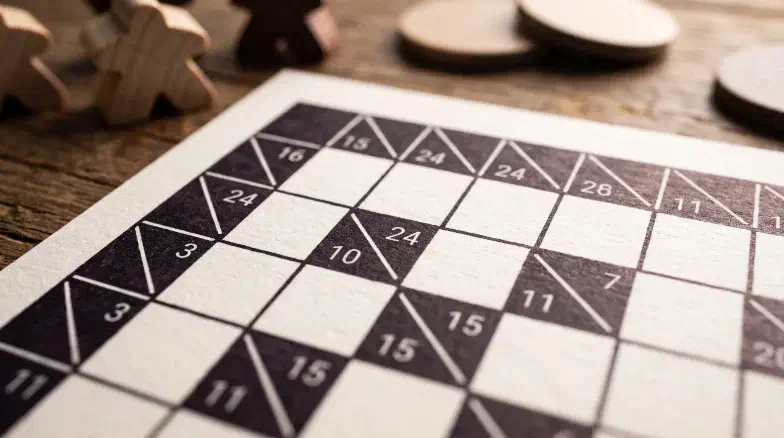
You’re twenty minutes into a hard Kakuro, and you’ve just worked out 17 in two cells for the third time tonight. 9 and 8. You knew that. You also knew it the last two times, and you still ran the arithmetic, because the habit hasn’t moved from your head to your eyes yet.
That small tax adds up. Every sum you recompute is attention you don’t spend on the part of the grid that’s hard. Solvers who move fast on expert grids aren’t doing faster mental math. They’ve stopped doing math for a short list of clues, because those clues have exactly one answer and they recognize them on sight.
Conceptis Puzzles calls these clues magic blocks: a clue and a cell count that only one set of digits can satisfy. Entries of two to five cells have just sixteen magic blocks in total, and you already know a few.
2-Cell Magic Blocks
The Extremes
Two rules create every magic block. You only get digits 1 through 9, and no digit can repeat inside a single entry (the run of white cells one clue covers). Those two rules pinch the ends of the number range.
The smallest sum two different digits can make is 1 + 2 = 3. The largest is 9 + 8 = 17. One step in from each end, you still have one option, because the alternative needs a repeat:
| Clue | Cells | Only combination | Why |
|---|---|---|---|
| 3 | 2 | {1, 2} | Nothing smaller exists |
| 4 | 2 | {1, 3} | 2 + 2 repeats |
| 16 | 2 | {7, 9} | 8 + 8 repeats |
| 17 | 2 | {8, 9} | Nothing larger exists |
These four are your primary entry points because two-cell entries are the most common entries in almost every grid. If you have only memorized one set, make it this one. A shortcut: the high pairs mirror the low pairs around 10. Swap 1 for 9, 2 for 8, 3 for 7, and {1, 2} becomes {9, 8} while {1, 3} becomes {9, 7}.
Near-Extremes
One more step toward the middle, the options split in two. 5 in two cells is {1, 4} or {2, 3}. 15 in two cells is {6, 9} or {7, 8}. Neither is a magic block, and treating them like one is the most common cheat-sheet error.
Near-extremes still do work for you. A 5 can never hold a digit above 4, and one known digit settles the other. A 5 is also always one odd digit plus one even digit, since an odd total from two cells needs one of each. If a crossing clue tells you one cell is odd, the other is even, and that alone often decides which pair you’re looking at.
3-Cell Magic Blocks
Low End Combinations
Three cells give you four more:
| Clue | Cells | Only combination |
|---|---|---|
| 6 | 3 | {1, 2, 3} |
| 7 | 3 | {1, 2, 4} |
| 23 | 3 | {6, 8, 9} |
| 24 | 3 | {7, 8, 9} |
The low pair, 6 and 7, does its best work in corners. A corner cell sits at the start of both an across entry and a down entry, so it collects two constraints at once. Put a 7-in-three across a 4-in-two down and the shared cell has to come from {1, 2, 4} and {1, 3} at the same time. Only 1 survives.
High End Combinations
23 and 24 work the other way. Every cell in a 24 is 7 or higher, so each crossing entry loses its low digits at that cell. If a 24-in-three crosses a 12-in-two, the 12 could be {3, 9}, {4, 8}, or {5, 7}, but the shared cell can’t be 3, 4, or 5. It has to take the big half of whichever pair it is, and the 12’s other cell has to take the small half. Six candidates in the shared cell become three, and you haven’t written a single pencil mark.
Larger Block Extremes (4 & 5 Cells)
The 4-Cell Constants
Four cells have magic blocks at 10 {1, 2, 3, 4}, 11 {1, 2, 3, 5}, 29 {5, 7, 8, 9}, and 30 {6, 7, 8, 9}.
A 10 in four cells is a wall of small digits. Every cell in it is 4 or lower, so every entry that crosses it gets a cell capped at 4. A crossing 16-in-two {7, 9} can’t share a cell with it at all, and a valid puzzle will never ask it to. A crossing 9-in-two {1, 8}, {2, 7}, {3, 6}, {4, 5} keeps all four pairs, but its shared cell is forced to the small half of each.
The 5-Cell Constants
Five cells have four magic blocks too: 15 {1, 2, 3, 4, 5}, 16 {1, 2, 3, 4, 6}, 34 {4, 6, 7, 8, 9}, and 35 {5, 6, 7, 8, 9}. Most cheat sheets skip 16 and 34. Don’t: the worked example on Conceptis’ techniques page uses a 16 in five cells.
Five-cell blocks rarely hand you a digit by themselves. Their value is subtraction. Once the ends of a 15 are filled, the middle three come from whatever’s left of 1 through 5, and that leftover set is usually small enough to finish with one crossing clue.
Practical Example: Finding Entry Points
Here is a blank grid. Clue cells read down\across: 4\ is a down clue of 4, \15 is an across clue of 15, and 16\4 holds a down 16 and an across 4.
+-------+-------+-------+-------+-------+-------+
|#######|  4\   | 20\   |#######| 20\   |  3\   |
+-------+-------+-------+-------+-------+-------+
|   \3  |       |       | 16\4  |       |       |
+-------+-------+-------+-------+-------+-------+
|   \15 |       |       |       |       |       |
+-------+-------+-------+-------+-------+-------+
|#######| 16\6  |       |       |       | 17\   |
+-------+-------+-------+-------+-------+-------+
|   \35 |       |       |       |       |       |
+-------+-------+-------+-------+-------+-------+
|   \17 |       |       |   \16 |       |       |
+-------+-------+-------+-------+-------+-------+
Step 1: Scan every across clue. Count each entry’s cells and check the clue against your list. You find \3 (2 cells), \4 (2 cells), \15 (5 cells), \6 (3 cells), \35 (5 cells), \17 (2 cells), and \16 (2 cells). All seven across clues are magic blocks.
Step 2: Scan every down clue. 4\ (2 cells), 3\ (2 cells), 16\ (2 cells, bottom left), and 17\ (2 cells, bottom right) are magic. The two 20s in five cells and the 16 in three cells are not.
Step 3: Pencil in the sets. Where a cell sits in two magic blocks, write only the digits both blocks allow:
+-------+-------+-------+-------+-------+-------+
|#######|  4\   | 20\   |#######| 20\   |  3\   |
+-------+-------+-------+-------+-------+-------+
|   \3  |   1   |  1 2  | 16\4  |  1 3  |   1   |
+-------+-------+-------+-------+-------+-------+
|   \15 |  1 3  |  1-5  |  1-5  |  1-5  |  1 2  |
+-------+-------+-------+-------+-------+-------+
|#######| 16\6  | 1 2 3 | 1 2 3 | 1 2 3 | 17\   |
+-------+-------+-------+-------+-------+-------+
|   \35 |  7 9  |  5-9  |  5-9  |  5-9  |  8 9  |
+-------+-------+-------+-------+-------+-------+
|   \17 |   9   |  8 9  |   \16 |  7 9  |   9   |
+-------+-------+-------+-------+-------+-------+
All four corners collapse at once. Top left: the across 3 allows {1, 2}, the down 4 allows {1, 3}, and the only shared digit is 1. Top right is the mirror: 4 across {1, 3} against 3 down {1, 2}, so 1 again. The bottom corners do the same thing at the high end, with 17 against 16 leaving 9 both times.
Each corner digit finishes its partners. The 3 across needs a 2 next to the 1. The 4 down needs a 3 under it. Work all four corners and the grid fills in fast:
+-------+-------+-------+-------+-------+-------+
|#######|  4\   | 20\   |#######| 20\   |  3\   |
+-------+-------+-------+-------+-------+-------+
|   \3  |   1   |   2   | 16\4  |   3   |   1   |
+-------+-------+-------+-------+-------+-------+
|   \15 |   3   | 1 4 5 | 1 4 5 | 1 4 5 |   2   |
+-------+-------+-------+-------+-------+-------+
|#######| 16\6  |  1 3  | 1 2 3 |  1 2  | 17\   |
+-------+-------+-------+-------+-------+-------+
|   \35 |   7   | 5 6 9 | 5 6 9 | 5 6 9 |   8   |
+-------+-------+-------+-------+-------+-------+
|   \17 |   9   |   8   |   \16 |   7   |   9   |
+-------+-------+-------+-------+-------+-------+
The five-cell rows paid off exactly as promised. Row two already holds 3 and 2, so its middle is {1, 4, 5}. Row four holds 7 and 8, so its middle is {5, 6, 9}. In row three, the column above has already used a 2 in column two and a 3 in column four, so those two cells drop to {1, 3} and {1, 2}.
Twelve cells are solved and you haven’t added a single non-magic clue. The finish takes one sum. The right-hand 20 down already holds 3 and 7, so its middle three cells total 10, with one cell from {1, 4, 5}, one from {1, 2}, and one from {5, 6, 9}. Only 4 + 1 + 5 works. That 1 finishes row three as 3, 2, 1, and the left-hand 20 down then needs its two open cells to total 7, which only 1 + 6 manages.
+-------+-------+-------+-------+-------+-------+
|#######|  4\   | 20\   |#######| 20\   |  3\   |
+-------+-------+-------+-------+-------+-------+
|   \3  |   1   |   2   | 16\4  |   3   |   1   |
+-------+-------+-------+-------+-------+-------+
|   \15 |   3   |   1   |   5   |   4   |   2   |
+-------+-------+-------+-------+-------+-------+
|#######| 16\6  |   3   |   2   |   1   | 17\   |
+-------+-------+-------+-------+-------+-------+
|   \35 |   7   |   6   |   9   |   5   |   8   |
+-------+-------+-------+-------+-------+-------+
|   \17 |   9   |   8   |   \16 |   7   |   9   |
+-------+-------+-------+-------+-------+-------+
Best Practices and Tips
Do:
- ✓ Memorize the 2-cell and 3-cell extremes first: 3, 4, 16, 17 and 6, 7, 23, 24. They appear in nearly every grid.
- ✓ Keep a printed cheat sheet next to the puzzle until you stop glancing at it.
- ✓ Look for cells where two magic blocks cross before anything else. That’s where digits appear for free.
Don’t:
- ✗ Try to memorize every combination for mid-range sums. 13 in three cells has seven different sets. Work those out when you need them.
- ✗ Commit a digit to a magic block cell before checking the crossing clue.
Speed tip: Make flashcards with the clue and cell count on the front (for example, “23 / 3”) and the set on the back. A few minutes a day covers the 2- and 3-cell blocks faster than you’d expect.
Troubleshooting Common Issues
“I know the combination, but not the order.”
- Cause: Neither cell has a crossing constraint yet.
- Fix: Leave both digits as small pencil marks in both cells and work elsewhere. The crossing entry will eventually take one option away.
- Prevention: Don’t guess the order. Half the time you’ll be wrong, and you won’t find out until ten moves later.
“My magic block came out with the wrong digits.”
- Cause: You miscounted the cells. 16 in two cells is {7, 9}. 16 in three cells has eight possible sets.
- Fix: Count the white cells between the clue and the next black square before reaching for the cheat sheet.
“I treated 5 or 15 as unique.”
- Cause: Near-extremes look like magic blocks.
- Fix: 5 in two cells is {1, 4} or {2, 3}, and 15 is {6, 9} or {7, 8}. Pencil both pairs and let a crossing clue choose.
The Full Cheat Sheet
| Cells | Low magic blocks | High magic blocks |
|---|---|---|
| 2 | 3 {1,2} · 4 {1,3} | 16 {7,9} · 17 {8,9} |
| 3 | 6 {1,2,3} · 7 {1,2,4} | 23 {6,8,9} · 24 {7,8,9} |
| 4 | 10 {1,2,3,4} · 11 {1,2,3,5} | 29 {5,7,8,9} · 30 {6,7,8,9} |
| 5 | 15 {1,2,3,4,5} · 16 {1,2,3,4,6} | 34 {4,6,7,8,9} · 35 {5,6,7,8,9} |
Longer entries have magic blocks too, and the 45 Rule shows you how to read them without another table.
Conclusion
Key takeaways:
- Magic blocks are your entry points. Every expert solve starts with them.
- For two cells, 3, 4, 16, and 17 are the ones that matter most.
- For three cells, learn 6, 7, 23, and 24.
- The win is recognition, not arithmetic. Once you see the clue and the set together, you stop paying the math tax.
Next steps: Print the cheat sheet and keep it beside your next puzzle. When the corners start falling without it, move on to reading what happens where entries cross.
Keep reading in this series:
- Previous: The Ultimate Guide to Advanced Kakuro Tactics
- Next: Mastering the 45 Rule in Kakuro
- Related: Intersection Logic: Cross-Referencing Kakuro Clues