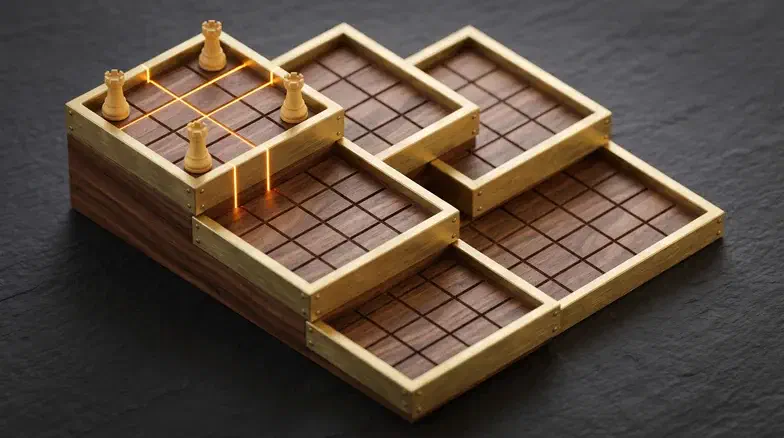
You open your first logic grid and the chart looks like a spreadsheet that lost half its boxes falling down the stairs. Category names run across the top and down the left side. Thick black lines chop everything into smaller squares. The bottom-left corner has a block, the bottom-right corner doesn’t. You tap one square to try it out and seven squares change at once.
None of that is you being bad at logic. The clues haven’t even started yet. You’re stuck on the board itself, and the board follows three simple rules that nobody bothered to explain.
Why the Grid Is Shaped Like a Staircase
Every Pair of Categories Meets Exactly Once
Death on the Night Mail has three categories: Passenger, Compartment, and Luggage. To solve it, you need to answer three kinds of question. Which passenger had which compartment? Which passenger carried which luggage? Which luggage sat in which compartment?
That’s three pairings, so the grid has three blocks:
               Compartment    Luggage
            +-------------+-------------+
 Passenger  | Passenger × | Passenger × |
            | Compartment | Luggage     |
            +-------------+-------------+
 Luggage    | Luggage ×   |
            | Compartment |
            +-------------+
The missing bottom-right block would be Luggage × Luggage, which asks nothing. And there’s no separate Compartment × Passenger block, because the top-left block already asks it. The staircase is what’s left when you remove every duplicate and every self-comparison.
Add a fourth category and you add three new pairings. Death at Ravenscroft Manor crosses Guest, Room, Object, and Time:
              Room        Object       Time
           +----------+----------+----------+
  Guest    | Guest ×  | Guest ×  | Guest ×  |
           | Room     | Object   | Time     |
           +----------+----------+----------+
  Time     | Time ×   | Time ×   |
           | Room     | Object   |
           +----------+----------+
  Object   | Object × |
           | Room     |
           +----------+
Notice the left-side labels below the first row run in reverse order: Time, then Object. That’s what makes each row one block shorter than the one above. Time already met Guest in the top row, so its row only needs Room and Object. Object already met Guest and Time, so it only needs Room.
The general formula is C × (C − 1) ÷ 2 blocks for C categories. Here’s how that scales:
| Grid | Categories | Items each | Blocks | Squares | ●s when solved | Example |
|---|---|---|---|---|---|---|
| 3 × 4 | 3 | 4 | 3 | 48 | 12 | Death on the Night Mail |
| 4 × 4 | 4 | 4 | 6 | 96 | 24 | Death at Ravenscroft Manor |
| 4 × 5 | 4 | 5 | 6 | 150 | 30 | The Last Sitting at Hollowmere |
| 5 × 5 | 5 | 5 | 10 | 250 | 50 | Five-category magazine grids |
Going from three categories to four doubles the board. Going from four items to five adds half again.
Reading a Single Square
Every square sits where one row label meets one column label, and it asks one yes-or-no question about those two items.
In the top-left block of Night Mail, the square where Mr. Quill meets Compartment 3 asks: “Was Mr. Quill in Compartment 3?” Drop down to the bottom block and the row labels switch from passengers to luggage, while the column labels stay the same compartments. Now the square under Compartment 3 in the Birdcage row asks: “Was the birdcage in Compartment 3?”
Before you mark anything, touch the row label and the column label with your eyes. Half of all beginner mistakes are a correct deduction placed in the wrong block.
How ✕ and ● Behave Inside a Block
One Dot per Row, One Dot per Column
Inside any single block, each row item matches exactly one column item. Four passengers, four compartments: nobody shares a compartment and none sits empty. So a finished 4 × 4 block always looks like four rooks on a mini chessboard that can’t attack each other (X = ✕, O = ●):
      C1  C2  C3  C4
  A   X   O   X   X
  B   X   X   X   O
  C   O   X   X   X
  D   X   X   O   X
Four ●s, twelve ✕s, one ● in every row and every column. Every solved block in every logic grid has this shape. Mathematicians call it a permutation matrix; you can call it “done.”
Auto-Elimination, and Where It Stops
That one-per-row rule is why a single ● is so powerful. Say you’ve worked out that Miss Ingram was in Compartment 3. Two things become impossible at once:
- Miss Ingram wasn’t in Compartments 1, 2, or 4. Her other three squares in the row get ✕.
- Nobody else was in Compartment 3. The other three squares in that column get ✕.
Passenger × Compartment               Passenger × Luggage
                  C1  C2  C3  C4          Hat  Carpet  Laud.  Bird
Mrs. Fairweather   .   .   X   .           .     .      .      .
Captain Royle      .   .   X   .           .     .      .      .
Miss Ingram        X   X   O   X           .     .      .      .   <- untouched
Mr. Quill          .   .   X   .           .     .      .      .
One ● settled 7 of the block’s 16 squares. That’s the “seven squares changed at once” from the opening: in the browser cases, tapping a square twice places a ● and fills the rest of its row and column with faded ✕s.
Now look to the right. Miss Ingram’s row in Passenger × Luggage is still blank. Auto-elimination stops at the thick border. Knowing her compartment doesn’t tell you her luggage. It might later, once you connect it to a luggage clue about Compartment 3, but that connection is a deduction you make, not something the grid does for you. Carrying ✕s straight across the border is the classic way to wreck a grid.
Finding “Last Square Standing” Singles
Row Singles and Column Singles
The reverse of auto-elimination: when a row inside a block has every square but one crossed out, the last square must be ●. On a 4 × 4 block that means three ✕s; on a 5 × 5 block, four.
You’ll spot row singles without trying, because you read left to right. Column singles hide. Here are both:
Row single (Ravenscroft, Guest × Time)
              9:00  9:15  9:30  9:45
Dr. Pryce      X     .     X     X       <- 9:15 is the only square left: ●

Column single (Night Mail, Passenger × Compartment)
                    Comp 3
Mrs. Fairweather      X
Captain Royle         X
Miss Ingram           .                  <- only square left in the column: ●
Mr. Quill             X
Ravenscroft’s Clues 1 and 3 give you Dr. Pryce’s 9:45 and 9:30 ✕s directly; the 9:00 ✕ arrives later in the solve, and the moment it does, his row resolves. The Compartment 3 column is the opening breakthrough of Night Mail, covered in the example below and finished in Cracking Ordered Clues.
After every wave of ✕s, scan each block twice: once across, once down.
Practical Example: Opening Moves on Death on the Night Mail
Here are the first two clues of Death on the Night Mail, marked on the actual grid. This doesn’t give away the killer.
Clue 1: “The passenger in Compartment 3 was either Mr. Quill or Miss Ingram.”
- Find the right block. “Passenger” and “Compartment” meet in the top-left block.
- Find the line. The clue is about one compartment, so work down the Compartment 3 column.
- Mark what’s ruled out. It was Mr. Quill or Miss Ingram, so it wasn’t Mrs. Fairweather and it wasn’t Captain Royle. Two ✕s. Don’t place a ● on either name; you don’t know which one yet.
Clue 4: “The passenger in Compartment 2 was not Captain Royle.”
- Same block. One ✕ at Captain Royle / Compartment 2.
Passenger × Compartment after Clues 1 and 4
                    C1   C2   C3   C4
Mrs. Fairweather    .    .    X    .
Captain Royle       .    X    X    .
Miss Ingram         .    .    .    .
Mr. Quill           .    .    .    .
Two clues, three ✕s, and the block already has shape. Compartment 3 is down to {Miss Ingram, Mr. Quill}. Captain Royle is down to {Compartment 1, Compartment 4}. Clue 5 is a compartment-ladder clue, and it collides with that Compartment 3 column to drop the first ●. Try it yourself before reading the next article.
Best Practices and Tips
Do:
- Check both labels before every mark: the row label on the left and the column label on top.
- Scan columns for single survivors as often as you scan rows.
- Treat each block as its own small puzzle with its own one-per-row, one-per-column rule.
Don’t:
- Don’t place a ● for an “either A or B” clue. Cross out everything except A and B.
- Don’t carry ✕s across a thick border into the next block.
- Don’t fill a whole row with ✕s. If a row has no open square left, an earlier mark is wrong.
Troubleshooting Common Issues
You tapped ● instead of ✕ and half the block filled with faded ✕s. In the browser cases, the tap cycle is blank → ✕ → ● → blank. Tap the ● once more to clear it. The faded ✕s that only existed because of that ● disappear with it, and any ✕ you placed by hand stays put. Tap again for the ✕ you meant.
A row has no open squares. Something upstream is wrong. The usual cause is a correct deduction marked in the wrong block, often the bottom block, where the row labels change category. Read the two labels on each ✕ in that row and check them against the clue that produced it.
The grid looks the wrong shape for the puzzle. Count categories, not items. Three categories always give three blocks; four give six, whether each category has four items or five.
Conclusion
The staircase is just bookkeeping, and it follows four rules:
- A grid with C categories folds into C × (C − 1) ÷ 2 blocks, so every pair of categories meets in exactly one place.
- Each finished block holds exactly one ● per row and one ● per column.
- A ● clears its row and column inside its own block and stops at the thick border.
- A row or column with one open square left is a ●. Scan both directions.
With the board under control, finish Death on the Night Mail in your browser, then compare its three blocks with the six in Death at Ravenscroft Manor. If you play Kakuro too, Kakuro Rules Explained: Grid Mechanics and Clue Splits covers the same “know your board before you read the clues” groundwork for number grids.
Keep reading in this series:
- Pillar guide: How to Solve Logic Grid Puzzles: From Basic Elimination to Murder Mystery Deduction
- Next: Cracking Ordered Clues: How to Solve “Earlier Than” and Exact-Gap Ladders
- Mastering “Either/Or” and “One of These Two” Clues in Logic Grids