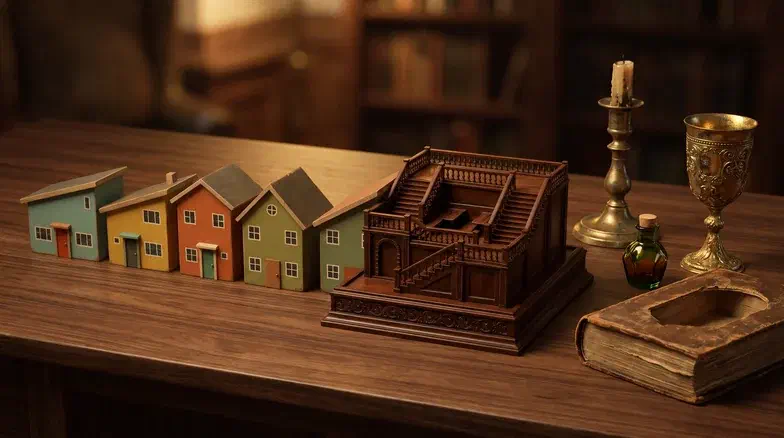
Somebody slides a printout across the table. Five houses in a row, five nationalities, five drinks, five brands of cigarette, five pets. “Einstein wrote this,” they tell you. “Only two percent of people can solve it.” You draw five columns on a napkin, label them House 1 to House 5, and forty minutes later you know who owns the zebra.
Einstein didn’t write it. Nobody has turned up evidence for the two percent either. But the puzzle is real, and the same structure (a handful of categories, every item matched to exactly one item in each other category, a list of true clues) sits under every murder mystery logic grid you’ll find today. The napkin method doesn’t carry over, though, and the reason why explains the strange staircase-shaped chart that murder mysteries use instead.
The Zebra Puzzle vs. the Staircase Grid
Why Einstein’s Riddle Fits in a Five-Column Table
The puzzle ran in Life International on December 17, 1962, as a list of fifteen statements ending in two questions: who drinks water, and who owns the zebra? Neither water nor a zebra appears anywhere in the clues. Life printed the solution in March 1963, along with the names of several hundred readers who had sent in correct answers. The Einstein attribution showed up later and has no support. Neither does the older claim that Lewis Carroll wrote it: some of the cigarette brands didn’t exist in his lifetime.
What makes the Zebra Puzzle solvable on a napkin is that its clues hang everything on house position:
- “The Norwegian lives in the first house.”
- “Milk is drunk in the middle house.”
- “The green house is immediately to the right of the ivory house.”
Two of those place an item in a numbered house from the very first read. So you write the houses across the top and fill facts straight into the columns:
          House 1     House 2   House 3   House 4   House 5
Nation    Norwegian
Color
Drink                           Milk
Smoke
Pet
Every other clue gets checked against those anchors. The table works because something always has a fixed address.
Why Murder Mysteries Need the Staircase
Murder mystery clues rarely give anything a fixed address. Nobody walks up and says “Colonel Ashby was in the Library at 9:00 with the candlestick.” Instead you get clues like this one from Death at Ravenscroft Manor:
“The guest in the Conservatory was seen exactly fifteen minutes before the guest in the Wine Cellar.”
Try putting that on a guest table. The columns are guests, and you don’t know which guest was in the Conservatory. There’s no square to write in. You end up keeping it in a note in the margin, and on a nine-clue case the margin fills up fast.
The staircase grid gives every pair of categories its own block, so that clue has a home on the first read:
Time × Room              (X = ✕, . = blank)
          Library  Conservatory  Billiard Rm  Wine Cellar
9:00 PM      .          .             .            X       <- Cellar can't be first
9:15 PM      .          .             .            .
9:30 PM      .          .             .            .
9:45 PM      .          X             .            .       <- Conservatory can't be last
Two ✕s recorded, and no guest named yet. Later, when you learn who was in the Conservatory, you copy those marks across. That trade is the whole design:
| Zebra-style table | Staircase grid | |
|---|---|---|
| Needs anchored items at the start | Yes (a house number) | No |
| Records “A was not B” between two non-suspect items | Only after one is placed | Immediately, in its own block |
| Where secondary links live | Margin notes | Lower blocks (Time × Room, Floor × Entrance) |
| Squares for 4 categories of 4 | 16 fill-in boxes | 96 ✕/● squares |
Dell’s logic problem magazines made the staircase the newsstand standard, and G. T. Karber’s Murdle, which started as a daily online puzzle in 2022 before becoming a bestselling book series, put it in front of a new generation of mystery readers.
How a Logic Grid Becomes a Murder Mystery
A plain logic grid matches every suspect to one room, one object, and one time. It turns into a whodunit when the story names one square that matters. There are three common ways to do it.
- The weapon rule. The story tells you how the victim died, and whoever is matched with that item is the killer. In Death on the Night Mail, the brandy was laced with laudanum, so whoever carried the laudanum bottle did it. Curtain Call at the Gaslight Theatre uses a poisoned goblet; The Last Sitting at Hollowmere, an arsenic paper hidden in a hollowed-out prayer book.
- The crime-scene rule. The story fixes the location. The cook found Lord Ravenscroft dead on the conservatory floor, so whoever the butler passed in the Conservatory is the killer.
- The liar rule. Each suspect makes a statement, everyone tells the truth except the murderer, and you work out whose statement can’t hold. Murdle uses this in some of its cases.
The first two keep every clue true, so the whole case solves by marking the grid. The liar rule adds a different skill: testing “what if this statement were false?” and following it until something breaks. All four browser cases here use the first two rules. Hollowmere’s story puts it plainly: the maid “mixes the details up, but she never says anything that isn’t true.”
One detail trips people up. Finding the killer’s square doesn’t finish the case. In the browser grids, the case closes when the whole grid is correct, which is the logic-grid version of accounting for every alibi in the house.
How We Make Sure You Never Have to Guess
Nothing ruins a thirty-minute case like reaching the end and finding two suspects you could swap, or realizing the only way past Clue 3 was a coin flip. Every Motley Play logic grid is built by our Python generator, logic_grid_generator.py, and it has to pass a stricter test than “has one answer.”
The generator works in four stages:
- Pick a hidden answer. It shuffles the items into a random solution.
- Collect true clues. It writes a pool of clues across the six clue types, all true of that answer, then shuffles them, weighted toward ordered, either, and pair clues and away from direct giveaways.
- Add clues until deduction alone works. It keeps adding clues until its solver can fill the whole grid by propagation, with no trial and error.
- Strip out every clue it doesn’t need. It tries removing each clue in turn, direct matches first, and keeps the removal whenever the puzzle still solves by deduction.
Here’s the core of stages 3 and 4, lightly trimmed, with comments added:
def solves_by_deduction(self) -> bool:
    # Start with every item able to match anyone.
    D = self.initial_domains()
    # propagate() applies one-per-row/column rules and every clue,
    # over and over, until nothing changes. No guessing branches.
    # The puzzle passes only if every item ends with exactly one match.
    return self.propagate(D) and all(len(s) == 1 for s in D.values())


def acceptable(categories, clues, deductive) -> bool:
    solver = Solver(categories, clues)
    if deductive:
        return solver.solves_by_deduction()       # the strict test
    return len(solver.solutions(limit=2)) == 1    # the loose test: unique answer


# Pruning: try dropping each clue, direct "same" clues first.
removal_order = sorted(chosen, key=lambda c: (c.kind != "same", rng.random()))
for clue in removal_order:
    trial = [c for c in chosen if c is not clue]
    if acceptable(categories, trial, deductive):
        chosen = trial    # that clue wasn't needed; leave it out
The difference between those two tests matters. A puzzle can have exactly one answer and still force you to guess, if the only way to find it is “try Colonel Ashby in the Library and see if anything breaks.” The deductive test rejects those puzzles. Every mark you need can be reached the way the earlier articles in this series describe.
Direct “same” clues go first in the pruning order, which is why Death at Ravenscroft Manor ended up with no direct matches at all: five negatives, two ladder clues, two pair clues. A separate validator re-checks each published case: every clue is true of the stored answer, and the clues allow exactly one solution. The same “one answer, no guessing” standard runs through our Kakuro work in How to Make Sure Your Kakuro Has Exactly One Solution and Build a Kakuro Solver and Generator in Python.
Practical Guide: Your Four-Case Playlist
All four cases run in the browser on desktop or mobile, with no sign-up. Your marks save on your device, so you can close a half-finished 150-square case and pick it up tomorrow. Play them in order; each one leans on one technique from this series.
| # | Case | Difficulty | Grid | Squares | Clues | Signature move |
|---|---|---|---|---|---|---|
| 1 | Death on the Night Mail | Easy, 10–15 min | 3 categories × 4 | 48 | 5 | A gap-of-2 compartment clue colliding with an either clue |
| 2 | Death at Ravenscroft Manor | Medium, 20–30 min | 4 categories × 4 | 96 | 9 | Splitting a 4 × 4 block into two locked 2 × 2 boxes |
| 3 | Curtain Call at the Gaslight Theatre | Medium, 20–30 min | 4 categories × 4 | 96 | 8 | Copying marks across a confirmed First Floor = Act IV link |
| 4 | The Last Sitting at Hollowmere | Hard, 30–45 min | 4 categories × 5 | 150 | 10 | Two pair clues sharing a name |
Case 1, Night Mail. A moneylender drinks a laudanum-laced brandy on the overnight train to Edinburgh. Four passengers, four compartments numbered from the engine back. Five clues, and the compartment ladder does most of the work. Practice with Cracking Ordered Clues.
Case 2, Ravenscroft Manor. Lord Ravenscroft dies in the Conservatory while the butler makes rounds every fifteen minutes. The jump to four categories doubles the board. Pair clues carve it up; see Mastering “Either/Or” and “One of These Two” Clues.
Case 3, Gaslight Theatre. An actor collapses mid-banquet in Macbeth, and the audience applauds. Acts and dressing-room floors both run in order, and the Floor × Entrance block bridges them. This is where Transitive Cross-Referencing pays off.
Case 4, Hollowmere. A fashionable Bath medium takes tea alone before her séance and is dead by the time the lamps are relit. Five sitters, five keepsakes, five arrival times a quarter-hour apart, and no clue names a match outright. Four of the ten clues are pair clues; find the two that share a name.
Best Practices and Tips for Mystery Solvers
Do:
- Read the story before the clues. It tells you which item names the killer: the laudanum bottle, the Conservatory, the goblet, or the prayer book.
- Strike through clues once their marks are fully on the board, but leave “earlier than” and gap clues live until both items are placed.
- Use the device save on the bigger cases. Hollowmere is a fine thing to leave half-solved overnight.
Don’t:
- Don’t follow a narrative hunch. The clergyman doesn’t have to own the prayer book, and the colonel doesn’t have to hold the candlestick. Only the clues count.
- Don’t use Check Solution to test guesses. It outlines contradicted marks and counts against your score, so save it for tracking down a mistake you can’t find.
Troubleshooting Common Issues
Jumping from 96 squares to 150 feels overwhelming. On a 4 × 4 block, two ✕s in a row leave a 50/50. On a 5 × 5 block, two ✕s still leave three candidates, so single-clue knockouts come slowly. Change tactics: look for two pair or either clues that share a name, which can take five candidates to one in a single step.
You found the killer but the case won’t close. The win condition is a complete, correct grid. Finish the remaining blocks; the last few rows usually fall out of cross-referencing in a minute or two.
You tried solving a mystery on a Zebra-style table and got lost. Switch to the staircase. Any clue that links two non-suspect categories (a room and a time, a floor and an act) needs a block of its own.
Conclusion
Sixty years separate the Zebra Puzzle from a browser murder mystery, and the core hasn’t changed:
- The Zebra Puzzle fits in a five-column table because its clues anchor items to numbered houses.
- Murder mystery grids use a staircase of C × (C − 1) ÷ 2 blocks so you can record links between any two categories, such as Time × Room or Floor × Entrance, before you know which suspect they belong to.
- A mystery grid is a matching puzzle plus one rule that turns a square into a culprit: the weapon, the crime scene, or the one lie.
- Every Motley Play case solves by deduction alone. The generator rejects any clue set that needs a guess, then removes every clue it doesn’t need.
Start with Death on the Night Mail, or browse cryptograms, connection boards, and escape rooms on the Playable Puzzles hub. If you’d rather hold your mystery in your hands, Escape the Crimson Gala: A Murder Mystery Escape Room Book opens every locked door with a Kakuro grid.
Keep reading in this series:
- Pillar guide: How to Solve Logic Grid Puzzles: From Basic Elimination to Murder Mystery Deduction
- Previous: Transitive Cross-Referencing: Syncing Sub-Grids to Break Mid-Game Stalls
- How Logic Grid Matrices Work: Sub-Grids, Rows, and Auto-Elimination
- Cracking Ordered Clues: How to Solve “Earlier Than” and Exact-Gap Ladders
- Mastering “Either/Or” and “One of These Two” Clues in Logic Grids