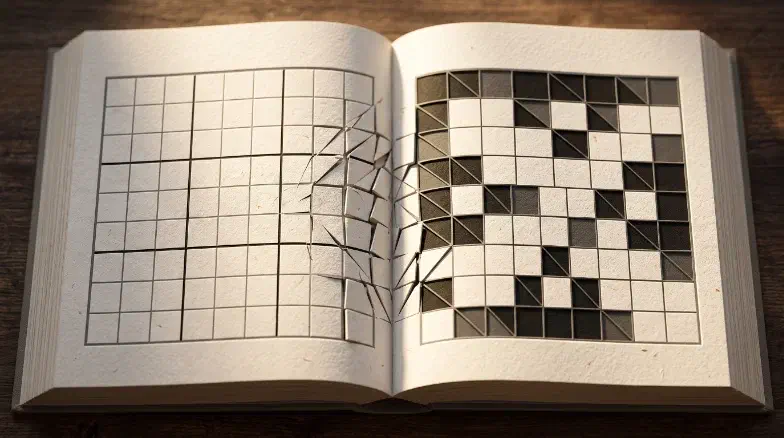
You can finish a hard Sudoku in ten minutes. You spot X-wings without trying, and naked pairs jump out at you. So you flip to the Kakuro page expecting a warm-up, and twenty minutes later you’ve placed four digits, erased three of them, and you’re refusing to write a 5 in a cell because there’s already a 5 further along the row.
That 5 is legal, by the way. You aren’t bad at Kakuro. You’re running Sudoku instincts on a puzzle that only looks similar. Both use the digits 1 through 9, both ban repeats, and both are solved with pencil marks and pure deduction. But the rules underneath work differently, and a few of your best Sudoku habits will steer you wrong.
What Stays the Same
The Logic-First Mindset
The most important skill carries over intact: you never guess. A well-made Kakuro has exactly one solution, and every digit can be proven, the same as a well-made Sudoku. The discipline you built, refusing to place a digit until you’ve earned it, is the most valuable thing you bring.
Your notation carries over too. Pencil marks (candidates) work exactly the same way: small digits in the corner of a cell, erased as they’re ruled out. If you already have a tidy candidate system, keep it.
And the digit range is the same: 1 through 9, no zeros. That’s where the overlap ends.
The Major Differences
Math Replaces the 3x3 Box
Sudoku has no arithmetic. The digits are just nine distinct symbols. You could replace them with nine colors or nine letters and every technique would still work. A 9 isn’t bigger than a 1. It’s just different.
In Kakuro, the digits are quantities. Every clue is a sum, and every deduction starts with “which digits can add up to this?” A 9 is worth nine 1s, and that changes how you think. Sudoku logic is spatial: where in this row can the 7 go? Kakuro logic is combinational: which sets of digits make 23 in three cells, and which of those fit here?
The grid is different too. Sudoku is always a 9x9 square with 81 cells and nine 3x3 boxes. Kakuro grids look like crosswords, come in many sizes, and have no boxes. Each constraint is a straight line of white cells between two black cells, and entries can be anywhere from two to nine cells long.
The Scope of the “No Duplicate” Rule
This is the one that trips up Sudoku players most.
- Sudoku: no repeated digit in any row, column, or 3x3 box.
- Kakuro: no repeated digit within a single entry. That’s all.
A Kakuro row can contain several separate entries, split by black cells. Each one is its own small problem with its own clue. The same digit can appear in every one of them.
+-------+-------+-------+-------+-------+-------+
|   \8  |   5   |   3   |   \14 |   5   |   9   |
+-------+-------+-------+-------+-------+-------+
The Boundary Logic
Why duplicates are legal across black cells:
graph TD
    A[Row] --> B[Black Cell Clue 8]
    A --> C[Black Cell Clue 14]
    B --> D[Entry 1: 5 + 3]
    C --> E[Entry 2: 5 + 9]
    D -.->|Isolated| E
    style D fill:#2d2d2d,stroke:#fff,stroke-width:2px,color:#fff
    style E fill:#2d2d2d,stroke:#fff,stroke-width:2px,color:#fff
Two 5s in the same row, just like the one you refused to write. In Sudoku, that’s an immediate error. Here it’s perfectly legal. The first 5 belongs to the across 8 (5 + 3), and the second belongs to the across 14 (5 + 9). The black cell between them ends one entry and starts a new one.
Treat every entry as its own small world. Once a black cell ends an entry, forget everything to the right of it.
Adapting Your Techniques
Naked Pairs to Unique Sums
Your Sudoku pattern-spotting doesn’t go to waste. Most techniques have a Kakuro counterpart, and some of them get easier.
Take naked pairs. In Sudoku, you work to discover that two cells in a unit can only hold {1,2}, and then you eliminate 1 and 2 from the rest of that unit. In Kakuro, a clue of 3 over two cells hands you that same {1,2} lock immediately, because 1 + 2 is the only way to make 3. These clues are called unique sums, and they’re your starting points.
The full naked-pair technique still works inside long Kakuro entries, too. If two cells in a six-cell entry are both locked to {8,9} by their crossing clues, no other cell in that entry can be an 8 or a 9.
Here’s how the rest of your toolkit translates:
| Sudoku habit | Kakuro equivalent |
|---|---|
| Starting from the given digits | Starting from unique sums: 3, 4, 16, and 17 in two cells |
| Scanning a row for its missing digit | Scanning entries for clues with only one combination |
| Naked pair locked to {1,2} | A 3 over two cells, which is {1,2} by arithmetic |
| Crossing row and column candidates | Cross-referencing a cell’s across and down entries |
| A row with one empty cell left | An entry with one empty cell: clue minus placed digits |
| No repeats in row, column, box | No repeats within a single entry |
That first row is worth repeating. Kakuro has no givens. The unique sums are your givens. You just have to recognize them.
If you want a gentler bridge, try Killer Sudoku. It uses a standard Sudoku grid, but its cells are grouped into dotted-line cages of two to nine cells, each marked with a sum, and digits can’t repeat within a cage. You get to practice the arithmetic side of Kakuro while the Sudoku rules you already know keep you on track.
Do’s and Don’ts
Do:
- ✓ Embrace the math. Memorize the common combinations the way you once memorized Sudoku patterns.
- ✓ Use your Sudoku scanning speed for cross-referencing. Checking an across entry against a down entry is a skill you already have.
- ✓ Keep your candidate notation exactly as it is.
Don’t:
- ✗ Scan a whole row from edge to edge looking for a missing digit. Look only at the entry between its black cells.
- ✗ Refuse a digit because it already appears elsewhere in the row. If a black cell separates them, it’s legal.
Troubleshooting Common Issues
“I keep refusing to place digits that are actually legal.” That’s Sudoku muscle memory. Before you rule out a digit for repeating, find the black cells at both ends of the entry and check only between them. After a few grids, the new boundary will feel natural.
“I can’t find anywhere to start. There are no given digits.” Kakuro gives you sums instead. Scan for clues near the extremes of what their entry can hold: 3 or 4 over two cells, 16 or 17 over two cells, 6 or 24 over three cells. Each one tells you its digits outright.
“I know the digits but can’t figure out the order.” Sudoku taught you to cross row candidates with column candidates. Do the same thing here with the across and down entries through the cell. The digit has to appear in both lists.
Conclusion
You already have the hardest skill Kakuro asks for: the patience to prove every digit before you write it. What changes is where your evidence comes from. In Sudoku it comes from position. In Kakuro it comes from addition.
Key takeaways:
- Kakuro requires addition. Sudoku doesn’t, and that changes how you start and how you deduce.
- The no-duplicate rule applies only within a single entry, not across a whole row or column.
- Your pencil marks, your scanning speed, and your refusal to guess are your biggest assets.
Next steps: Pick up a beginner Kakuro, run a unique-sum scan first, and leave your row-wide duplicate habit at the door.
Keep reading in this series:
- Previous: Common Kakuro Mistakes Beginners Make and How to Avoid Them
- Start here: The Complete Beginner’s Guide to Solving Kakuro